About Me

My photo
Nancy Simpson's LIVING ABOVE THE FROST LINE, New and Selected Poems was published by Carolina Wren Press (N.C. Laureate Series, 2010.) She is the author of ACROSS WATER and NIGHT STUDENT, State Street Press, still available on WWW at Alibris and Books Again. Her poems have been published in Southern Poetry Review, Prairie Schooner, The Georgia Review and other literary magazines. "Carolina Bluebirds" was published in THE POETS GUIDE TO THE BIRDS, Anhinga Press). "Grass" was reprinted in the 50th Anniversary Issue of Southern Poetry Review: DON'T LEAVE HUNGRY ( U.of Arkansas Press.) Seven poems were reprinted in the textbook, SOUTHERN APPALACHIAN POETRY,(McFarland.) Two poems were published in SOLO CAFE, Two more poems were published in SOLO NOVO."In the Nantahala Gorge" was published in Pisgah Review. "Studying Winter" was reprinted in Pirene's Fountain Anthology and "The Collection" in Collecting Life Anthology. Most recently, Southern Poetry Review Edited by James Smith, published "Our Great Depression," and The Southern Poetry Anthology Vol. VII: NORTH CAROLINA,Edited by William Wright, reprinted "Leaving in the Dead of Winter."
Showing posts with label Southern Appalachian Mountains. Show all posts

Tuesday, December 3, 2013

What Do They Do In Hayesville at Christmastime?


Hayesville Holiday Tour of Homes

Need a little help getting into the Christmas spirit?

Looking for decorating ideas to make your home a Christmas showcase?

You will get this and more at the Christmas Holiday Tour of homes this weekend—Saturday, Dec. 7 and Sunday, Dec.8.  Homes will be open 1:00 – 5:00 both days.

Tickets are $15 each and may be purchased early at the Library, Morning Song Gallery, Molly and Me, the Rustic Rose, and the 100 Exhibit.  Tickets may also be purchased at the Old Jail Museum on Saturday or Sunday.  If you are unable to purchase your ticket early, you may purchase it at the first home you visit on the tour.

The Clay County Historical and Arts Council sponsors the tour.  All proceeds help operate the Old Jail Museum and provide art opportunities for children and adults.


Sunday, November 17, 2013

AT THIS TIME OF YEAR


At this time of year, like a litany, I access and celebrate four 

major treasurers of my life:


I am thankful for my family, my amazing family--Tim, Lynn, Jeremy, Sarah and Savannah, Pearson, Becky and Amanda. What a blessing you are to me. I am thankful for how you care for me. At this particular time of year we celebrate the addition to our family of Jeremy, who arrived from Vietnam on November 20, 1975 at age six. We traveled to New York to meet him, flew him back to Georgia our ancestral home, and drove him to our home on Cherry Mountain. What a blessing Jeremy has been and a true son and brother, as if born into the family. I admit I thought back then that we were saving him from war. How mistaken I was, how arrogant that thought turned out to be, for we all know now Jeremy came to save us, each one of us, one by one in some way or the other.

I’m thankful for my friends, you who have given me your love and friendship, you who unconditionally and unselfishly have stood by me during all kinds of heartache and  during unbearable situations--those who have visited when I was sick, brought food or sent or brought crates of cooked food when I could not prepare my own. Thanks for your calls, flowers, Emails, cards, and for regular comments you left on my site. Your care is paying off, for I have been blessed with health and strength.


The Victory Rose


At this time of year, and daily I am thankful for my beloved pets--Queen of the Mountain Sasha (13 years of pure love) and young Roxy who has enough love to go around and much energy to share. They are most responsible for keeping me daily up and moving--saying “Let me out”, “Let me in,” Feed me, “Bath me,” “Give me my Frontline,”  “Spray my wounds,” and “Where is my “candy?”

Here at the end of the year, each year,I also celebrate my writing and acknowledge how much writing (both mine and yours) sustains me. This year, I especially appreciate having had my poem “Our Great Depression” included in the Georgia edition of Southern Poetry Review, chosen by James Smith, Editor, and having my poem “Pink Pantsuit” featured in Ted Kooser’s wide reaching newspaper column, and having my book LIVING ABOVE THE FROST LINE with  a number of poems included by Michelle Aldredge in the Sunday poetry feature of GWARLINGO. 

Life is good, and I am thankful.


http://www.gwarlingo.com/2013/the-sunday-poem-nancy-simpson/#comment-35562

Tuesday, September 10, 2013

Tuesday, October 23, 2012

October 2012 - A MOST BEAUTIFUL AUTUMN IN THE SOUTHERN APPALACHIAN MOUNTAINS


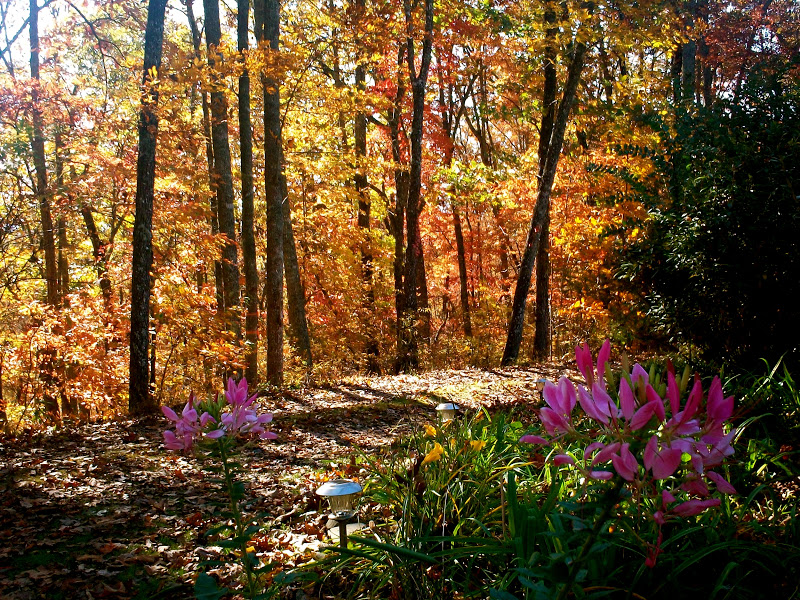
This fall is the most beautiful autumn in the Southern Appalachian Mountains. Yes, I know. I do say that almost every year. This season is more special to me, probably because I'm staying close to home and my children have been  around the house a lot more.  We have taken more opportunities to drive out and about in the  neighborhood.

"Living Above the Frost Line" we see flowers bloom until the hard freeze, sometimes after all of the leaves are on the ground.


Wednesday, October 27, 2010

LIVING ABOVE THE FROST LINE (BLOG) CELEBRATED ITS 2ND ANNIVERSARY


This Blog - LIVING ABOVE THE FROST LINE did celebrate on October 26,2010, its 2nd Year Anniversary. Living above the Frost Line is the cyber home of owner, poet  Nancy Simpson. A celebration of the blog is first of all, a celebration of all who have visited.  
WHAT IS THE FOCUS OF THE BLOG?  Poetry, Writing  and life in the Southern Appalachian Mountains.


As stated: “Living Above the Frost Line is a dwelling place for practicing poets. Here we give ourselves some extra time. Yes, we know the hard freeze will come, but until it arrives, we shall grow and share our poems.”
We’re sunrise watchers, moonrise watchers, sunset and moonset watchers. We’re obsessed with flowers and especially enjoy a full sun perennial garden growing on a mountain in the middle of a deciduous forest. The goal here always has been to see something blooming, even in the dead of winter, and that is sometimes possible. 

WHAT ARE THE HIGHLIGHTS OF THE PAST YEAR?  Some amazing things happened, but basically this site featured Appalachian or Southern Poets regularly:  Brenda Kay Ledford, Eric Nelson, Rachel Bronnum, Rosemary Royston, Maren O. Mitchell,  Ruth Moose, Dana Wildsmith, Mary Ricketson, Barbara Groce, and others. You can still read their poems by going to the archives.  Nancy Simpson’s all time favorite love poem was featured on Valentine’s Day:  “The Gathering” by James Haba.
All of the John C. Campbell Folk School Writing classes and most of the Institute for Continued Learning Writing Classes at Young Harris College were announced. Many poetry and other writing classes were posted with a class descriptions. Where to publish was discussed.
News of interest to writers living in the NC Writers’ Network West area south and west of Asheville was posted regularly. Many NCWriters’Network West events were announced.
WHAT IS THE MOST RECENT TALK ABOVE THE FROST LINE?   ECHOES ACROSS THE BLUE RIDGE -  Stories, Essays, and Poems by Writers Living in and Inspired By the Southern Appalachian Mountains, edited by Nancy Simpson,with a forward by major poet and writer Robert Morgan was published by Winding Path Publishing.  This anthology sold out fast and is now being reprinted. Discussion about using the anthology in Appalachian Studies has been heard behind the scenes. Book reviews have been reprinted on this site.  
and in the same month, same year...talk, talk talk,   the book LIVING ABOVE THE FROST LINE, New and Selected Poems by Nancy Simpson, a collection spanning 32 years of her poetry career, was published at Carolina Wren Press. The book LIVING ABOVE THE FROST LINE is the first book in Carolina Wren’s new Laureate Series. The manuscript was nominated by NC Poet Laureate Kathryn Stripling Byer and was launched at City Lights Book Store in Sylva, NC on Sunday, Oct. 17th. In that week it was named Appalachian Book of the Week. 


WHO READS THIS LIVING ABOVE THE FROST LINE BLOG?  There have been 16,397 visits to the site with the total of 31,395 pages viewed.  Visitors are from throughout the United States, from the southeast and into Colorado and California, with an average 4 minutes reading time spent on an average of 41 pages a day.  There are 34 Followers. Most inquiries come from writers searching for poems to read, for writing tips and for recent news of writing, especially Appalachian writing, southern writing, and poetry news. 
The biggest number of inquiries came in January 2010, by readers interested in winter in the southern Appalachian Mountains and The Full Wolf Moon.  February 2010 was also a big hit month with interest in NC Poet laureate Kathryn Stripling Byer 


and a post about southern writer Dana Wildsmith with  a reprint from her new book BACK TO ABNORMAL, Surviving With An Old Farm in the New South.  In March 2010, readers were interested in reading poems by MaryRicketson and Ruth Moose.
Over all, during the past two years, other than inquiring about poet Nancy Simpson, readers have been searching for any and all information about physician poet John Stone and Georgia poet Bettie M. Sellers.
For more info, search the archives 
or contact Nancy Simpson
nancy.simpson38@yahoo.com

Sunday, December 6, 2009

Hoar Frost, Rime in the Southern Appalachian Mountains

I appreciate the gentle way winter has introduced itself this year, with a light snow, and this morning, a lovely hoar frost in rime. Of course, it is not winter. It's fall. There are distractions.
I may not even know the day when winter formally arrives.
I'll take these gentle days as the
annoucement of a new beginning,
a new season, end of a decade so the beginning of a new decade, end of a journey so the arrival of a destiny, a new destination in my life.


Thursday, September 3, 2009

September - A Rumor From Above the Frost Line


Living Above the Frost Line is a dwelling place for practicing poets. Up here, we give ourselves some extra growing time. As said before, we know the hard freeze will come, but until it arrives we shall grow and share our poems. Flowers bloom here until the killing freeze.

September is a hardy month. Flowers are blooming across the ridge. Insects are active. Bees swarm everywhere, in fact, I have to watch that I don't cross their bee line. Butterflies thrive in a butterfuly bush heaven.


Autumn Joy


Aster with bees


My favorite pathway with Knock Out Roses, Crepe Myrtle, Cleome, False Sunflowers and Japanese Lanterns.


As to the poetry here above the frost line, rumor has it that the poems will bloom this year, perhaps even beyond the hard freeze. Impossible, I know. It's a rumor.


Buddelia devidii White Profusion Butterfly Bush

Friday, January 23, 2009

Cabin Fever, I Guess You Could Say


BEWARD OF HAIRPIN TURN

Some of you are thinking, she's obsessed with a specific poem and its line breaks. Others who know my situation would say, "She is obsessed, obsessed with her frozen road." Still others will defend me to the death, and they will say, "Give her a break. It's only a case of cabin fever."

Meanwhile, my car has been to the village and back and slid only on the switchback going down. I had to get a running start to climb back up the drive, but yes, my car is parked exactly where it is supposed to be now, and not stranded on the north ridge as it has been for days. The household is stocked with all we need, including copy paper, dog food, cat food, bird seed. After a week of lock up, the old mountain road is for most of the way navigable. All is well.

Sunday, January 18, 2009

Weather Report for Poets From Above the Frost Line - First Snow


Our first snow of 2009 fell last night and this morning, covering the road. The hard freeze did it's damaging deed in December. The only thriving plants are inside potted plants.

Poems? Yes, they thrive here above the frost line. So far, all our poems have endured the bitter cold of a southern Appalachian winter.

Tuesday, January 6, 2009

Dark Side, a poem by Nancy Simpson

Rain, Rain, go away I used to say when I was a child.  No one living in Southern Appalachia can say those words now after two summers of drought.  Deep in my heart, I am thankful for the rain falling on my plants, standing on my deck.  I now believe my perennials will return to a season of growing in the spring.  

But, I am normal.  January is hard enough on the soul.  Dark skies. Rain, Rain, Rain.  It gets you to thinking dark thoughts sometimes. Moods do not last.  Moods are ever changing.  We can be thankful for that.  If I had a poem to express my emotions today, I would choose "Dark Side."

I did not write "Dark Side" today nor even last night.  I wrote it so many years ago I can't say exactly.  I remember coming out of the Young Harris College Planetarium after a poetry program and planetarium show that presented poems about the night sky.  I was challenged to write one.  I was not depressed in the slightest and it was not raining.  It was a clear night. By the way, I was not an old woman.  That is why I would have to say, all these years later, you can never know what is going on in the head of a practicing poet.  I would guarantee you what is going on in the mind of the  poet  is almost never what you would think.  


DARK SIDE

Rain falls on my house
drumming up the old woman in me,
cave woman, afraid in the dark.
Rain makes a wall between earth and sky.
Not one star.  There is no moon
I say, blind in my belief,
but surely there are stars
and the moon is somewhere in the heavens,
stumbling, shoved along,
pushed over the edge maybe.

--Nancy Simpson, from  NIGHT STUDENT
published at State Street Press, 1985

Wednesday, December 31, 2008

Farewell to Three Poets Named John

Year 2008 ends with southern readers and writers forced to say farewell to three of our finest poets, all three named John. They are: (1) Jonathan Williams born March 8, 1929 in Asheville, North Carolina who died March 16, 2008 in Highlands, N.C. (2) John Foster West born December 10, 1918 in Wilkes County N.C. who died May 2, 2008. (3) physician poet, John Stone born February 7, 1936 in Jackson, Mississippi who died at his home near Atlanta on November 6, 2008.

Jonathan Williams, John Foster West, and John Stone were sons of the south, yet each became internationally known, making his mark as a poet. Poetry was greatly loved by these men, but being a poet was only a part of each of their profound lives.

Besides being an accomplished poet, Jonathan Williams was a world famous publisher and owner of The Jargon Society Press, the most renowned small presses in America. Many writers began their careers under his patronage, including Robert Creeley. Robert Duncan, Denise Levertov, Mina Loy and Jeffery Beam. Williams’s published work includes: An Ear in Bartram’s Tree (1969 U.N.C. Press), Blues& Roots/Rue & Bluets (1971 Grossman; 1985 Duke University) Quote, Unquote (1989 Ten Speed Press) A Palpable Elysium: Portraits of Genius and Solitude (2002 David ) The Magpie’s Bagpipe (1982 North Point) Blackbird Dust (2000 Turtle Point) Jubilant Thicket: New and Selected Poems with over 1000 of his poems (2005 Copper Canyon Press.) The Jargon Society archives are housed in Poetry and Rare Books at State University of New York, Buffalo, New York.

John Foster West is one of the most well known poets of the Southern Appalachian Region. Although I did not know him well, he invited me to read at Appalachian State as poet of the creative writing program in 1985. I have never forgotten his friendly southern manner. West was “the beloved teacher” to his students. He taught English for forty-two years before retiring from Appalachian State University in 1991 as professor emeritus. John Foster West’s poetry collections are: This Proud Land, Wry Wine and High Noon at Pompeii. He was well known for his novels: Time Was (Random House 1965) Appalachian Dawn (Random House 1973 ) The Summer People (1989 Appalachian Consortium Press) The Ballad of Tom Dula (1990 Moore Publishing). His novel, Time Was was nominated for a Pulitzer Prize. John Foster West’s papers are housed at Appalachian State University.

Dr. John Stone was Professor Emeritus of Cardiology at Emory University in Atlanta. He also taught English Literature at Emory and at Oxford University in England. His death this past fall stunned many. Only family and close friends knew he was ill. I first met John Stone at Callanwolde Fine Art Center in Atlanta when he served on the Poetry Committee. I heard him read his poems and speak at writing conferences many times around the south. Most recently, I heard him as the Byron Herbert Reese Speaker at Harris College. Those who knew John Stone say he loved and studied poetry all of his life. Dr. Stone had been heard to quote William Carlos Williams in saying that "he was married to medicine but that poetry was his mistress." As a poet, John Stone’s work was widely published. Louisiana State University Press counted him as their own. L.S. U. Press is where you will want to go if searching for his poetry collections: The Smell of Matches, (1972, and 1989), In All this Rain (1980) Renaming the Streets (1985) Where Water Begins: New Poems and Prose (1998) Music from Apartment 8: New and Selected Poems (2004) . In 1990 Dell published In the Country of Hearts: Journeys in the Art of Medicine, a collection of
essays . The book was reprinted by LSU Press in 1996. Dr. Stone co edited On Doctoring: Stories, Poems and Essays (Simon & Schuster 1991). More than 200,000 copies have been distributed to American medical students.

Jonathan Williams, John Foster West, Dr. John Stone: They are gone, these three phenomenal poets. They will be remembered. Their words shall endure.

Friday, December 26, 2008

AULD LANG SYNE - WHAT DO THESE WORDS MEAN?

Auld Lang Syne - What do these words mean?

Auld Lang Syne, sang throughout the world on New Year’s eve, was first published by Robert Burns, the Scottish poet in the 1700s. This was not his original thought. He said he “took it down from “an old man.” In fact, the first verse did exist in tradition, but Burns added other verses. The poem/song as we know it is attributed to Robert Burns. It was published after his death in 1796.

Scots spread the song though out the world. In 1929, Guy Lambardo, a Canadian band leader made Auld Lang Syne popular when he played it at the the New York New Year’s celebration.

In my life, I’ve sang Auld Lang Syne on New Year’s eve. I interpret Auld Lang Syne to mean: “Because we never want to forget old friends and that special time long ago, where ever I am and where ever you are, we’ll drink a 'cup of kindness' as a toast to the memories of that time gone by.”

Remembering old acquaintances and special times is necessary to some of us, to me for certain. Some of us cannot under any circumstance wish anyone a happy new year, until we have first gone through the process of “Auld Lang Syne.

For all of you who share history of any kind with me and I with you, “for 
Auld Lang Syne,” I wish you a Happy New Year.

Sunday, November 30, 2008

HALLOWS by Kathryn Stripling Byer

1.
These leaves at my window,
death-speckled black oak and blood maple,

fall to the earth into which
she was sealed, leaving me

to imagine I see through the hollows
of what were her eyes how another day

breaks on the backs of the scrub pines
that stand up to welcome it.

2.

She was no saint.
She never fasted,
and if she prayed,
I never heard her

aside from the Lawsy
she uttered as down
she sank onto the dark
of the chamber pot
while I tried to be sleeping.

She stirred up the fire
to roar every morning and beat
the dough smooth, shoved it into the oven
to bake and be eaten.  When I hear Pavarotti
sing Panis Angelicus, I see her hands 
deep in the dough bowl,

and I hear the fire in the stove rumble,
I hear her chuckling and sighing,
she who could never on this earth 
deliver unto any table a dry piece of cornbread,

whose old-fashion cakes 
that lay solid as flesh on the plates 
put to shame every paper-thin
slice of town ladies' angelfood cakes.
(Any honest-to-god-angel

would have preferred them,
a dollop of whipped cream atop
every thick slice and after that, oh,
just a touch of her Christmas divinity.)

3.
Los Muertos.  The dead.
They are out there this morning,
in the woods with the busy squirrels
laying up treasures on earth,
this heaven of acorns and walnuts.
This granary.

These last dawns before the leaves go,
I wake early to watch from the widow
my dead ones out there in the wood
leaf by leaf come
to rest on the ground
where at last they have nothing
to say beyond what's meant
to lie on the earth and be claimed by it.


Previously Published in Southern Poetry Review.
From COMING TO REST, Louisiana State University Press

Sunday, November 2, 2008

SOUTHERN POETS AND WRITERS - A REMINDER

Fellow Poets and Writers, 

___It is time to take those last shots, make your vivid photos and print them.

___It is time to photocopy your poems and stories and send them out on the mail truck.

December will be too late.  

Saturday, November 1, 2008

November 1, 2008 LIVING ABOVE THE FROST LINE MEANS:

Living above the frost line means - no frost up here on the mountain as yet. Each night,  the weatherman predicts below freezing temperatures.  I look out the next morning on flowers in full bloom.  Yes, it even snowed last Tuesday. Snowflakes rested for a few minutes on fuchsia sourwood leaves.  The Knock Out Roses were happy to get a drink, and not one of their blossoms withered from the snow.  The butterfly bushes, blooming since spring, are still sending up their cones of color.

Yes, yes.  I know the hard freeze will come, but until then, maybe through Thanksgiving, perhaps into the first week of December, I shall have flowers blooming in my garden, and I shall have finished poems on my clipboard.   That is what it means to live above the frost line. It means that  in this special dwelling place we get extended growing time.